Mechanical activity within an engine
creates shearing forces that can negatively affect a lubricant’s
protective viscosity. Even lubricants that provide consistent viscosity
through a wide temperature range (high viscosity index) are susceptible
to shearing forces that reduce viscosity and load carrying ability.
Engines operating at high RPMs and those that share a common oil sump
with the transmission are particularly subject to high shear rates.
In fact, gear sets found in motorcycle transmissions are the leading
cause of shear induced viscosity loss in motorcycle lubricants.
The ASTM D-6278 Viscosity Shear Stability Test is used to determine a
lubricant’s shear stability. After measuring its initial viscosity, the
oil is subjected to shearing forces in 30 cycle intervals.
Viscosity is measured and compared to the oil’s initial viscosity
following 30, 90 and 120 cycles. The lower the degree of change,
the better protection the lubricant provides against shearing forces.
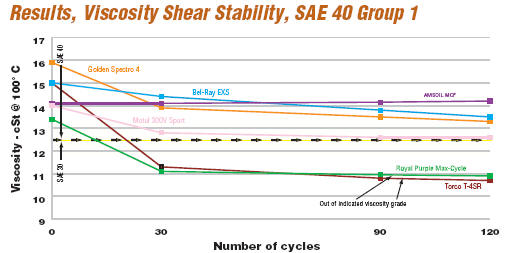
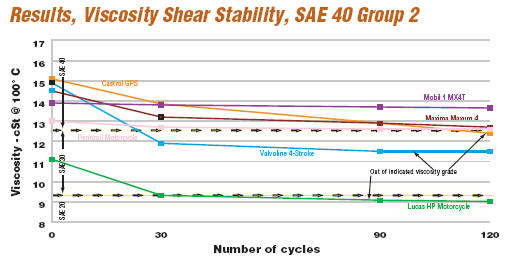
Two separate tests were performed for SAE
40 and SAE 50 oils, with each grade split into two or three groups to
make the graphs easier to reference. The flatter the line on the
graph, the greater the shear stability of the oil. The results
showed significant variances in shear stability protection. Within the
SAE 40 group, 41.6 percent of the oils dropped one viscosity grade to an
SAE 30, while 43.8 percent of the oils in the SAE 50 group dropped one
viscosity grade to an SAE 40. The viscosity loss tended to occur
quickly, with most of the affected oils dropping a viscosity grade
within the first 30 cycles of shearing. In addition, it is
interesting to note that two of the oils with the highest viscosity
indices, Torco T-4SR in the SAE 40 group and Yamalube 4R in the SAE 50
group, exhibited the largest drops in viscosity in their respective test
groups during shear stability testing.
As seen in the graphs, both AMSOIL 10W-40 Synthetic
Motorcycle Oil (MCF) and 20W-50 Synthetic Motorcycle Oil (MCV) placed at
the top of their respective test groups in the Viscosity Shear Stability
Test, indicating that AMSOIL Synthetic Motorcycle Oils are the best
choice for superior protection of motorcycle engines and transmissions.