Many motorcycle engines share a common lubricant
sump with the transmission, requiring the same oil to lubricate both
assemblies. Because engines and transmissions place different
demands on lubricants, an oil that provides good engine protection may
fail to provide adequate transmission protection. High sliding
pressures, shock loading and shearing forces applied by motorcycle
transmission gears place a great deal of stress on a lubricant, and it
is up to the oil’s viscosity and chemical additives to protect the gears
against wear.
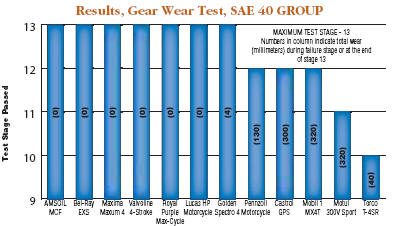
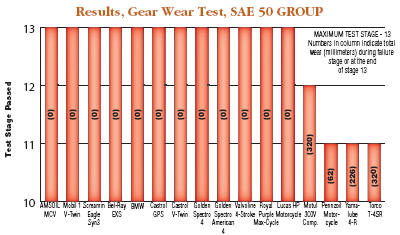
The ASTM D-5182 FZG Gear Wear Test is
used to determine a lubricant’s gear oil performance. Two hardened steel
spur gears are partially immersed in the test lubricant, while
temperature is maintained at a constant 194 degrees F and a
predetermined load is placedon the pinion gear. The gears are rotated at
1,450 RPM for 21,700 revolutions before being inspected for scuffing.
If the total width of wear on the pinion gear teeth
exceeds 20 mm, the test is terminated. If the total width of wear is
below 20 mm, additional load is placed on the pinion gear and the test
continues for another 21,700 revolutions. Each time an oil passes, it
advances to a higher test stage. The highest stage is 13, and results
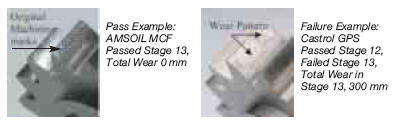
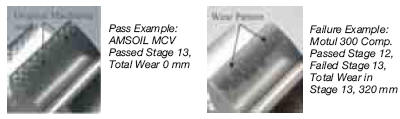
are reported as the highest stage passed by the oil. Wear is indicated
for the stage at which the oil failed.