OEMs Inflate Price of Inferior LubesTo Profit From Consumer Assumptions of Quality
Original equipment manufacturers (OEMs) typically recommend their own brands of motor oils and lubricants for their equipment. Consumers believe those “brandname” lubes are the best for the motorcycles, snowmobiles, ATVs, outboard motors and other recreational equipment they buy.
“Consumers often operate under the premise that the manufacturer not only knows what’s best for the equipment but also provides the best,” said Dave Anderson, AMSOIL technical product manager. “Their impression is that the OEM oils are always the best, and in many cases nothing could be further from the truth.” Anderson has more than 25 years of experience at AMSOIL and has conducted numerous comparison tests throughout that time.
Consumers falsely assume OEMs actually manufacture the oils and lubes that carry their brand name.
However, OEMs typically buy lowcost and sometimes low-quality oils from lubricant manufacturers, put their labels on them and send them out for distribution at dealerships.
“Manufacturers can command higher prices simply because the consumer perceives it to be more appropriate for the application,” Anderson said.
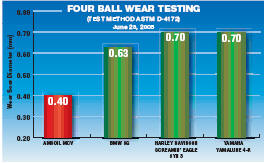
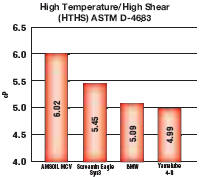
Contrary to consumer perception, research indicates OEM lubes often aren’t equal to the performance quality of the cheapest aftermarket oils on store shelves.
“Manufacturers probably do know more about the equipment,” Anderson said. “If indeed they know what’s best for their product, their lubricants should outperform – or at least meet the performance levels of – the other products out there. But results show that in most cases OEM oils were inferior to others.”
Consumers are sometimes led to believe that using any other oils or lubricants will void their factory warranties.
The federal Magnuson-Moss Act of 1975 was enacted to protect consumers. It says in part: “No warrantor of a consumer product may condition his written or implied warranty of such product on the consumer’s using, in connection with such product, any article or service (other than article or service provided without charge under the terms of the warranty) which is identified by brand, trade, or corporate name.” – United States Code, Title 15, Chapter 50, Section 2302 (c).
|
|
Copyright 2012 Oil Derek Distributing |