Change Gear Lube After Break-In Period for Long
Differential Life
Unbeknownst to many motorists, most differential wear occurs
during the break-in period. Change your gear lube to AMSOIL following the
break-in period in order to reduce wear and extend differential life.
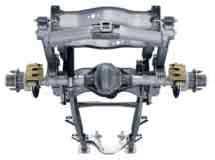 |
Motorists know
when they’re supposed to change their motor oil. They have oil life
monitors, oil change centers and commercials all telling them when it’s time
for an oil change. Differential oil changes, on the other hand, often get
overlooked. Many people don’t even think of the differential when performing
routine maintenance on their vehicles and don’t realize four-wheel drive
trucks have two differentials and a transfer case that all require service.
In fact, according to one quick lube company, only one to two percent of
their customers purchase a differential gear lube change. |
Most differential wear occurs during the break-in period.
Because differentials are not equipped with filters, break-in metals are
suspended in the oil, causing increased wear as the particles mesh between the
gears. Hauling heavy loads and towing heavy trailers cause additional stress to
the differential during the break-in period and can cause premature differential
damage or failure. Changing the gear lube after the break-in period (about
3,000 miles) is a low-cost maintenance investment that provides a significant
payoff, including greatly reduced wear, extended differential gear and bearing
life and protection for expensive vehicle investments. Auto manufacturers
recognize the importance of draining abrasive break-in materials. Some
manufacturers recommend an initial drain interval of between 500 and 3,000
miles.
Differential internal components consist of six gears (one
pinion, one ring, two side and two spider gears), six bearings (two pinion, two
carrier and two axle) and sometimes include a clutch setup for limited slip
performance. All of these parts require high quality, clean gear oil in
order to perform at an optimal level.
Most pickup trucks, SUVs and vans operate in severe service
conditions, including towing, hauling, steep hill driving, commercial use,
plowing, racing, off-road use, rapid acceleration, frequent stop-and-go
operation and high ambient temperatures. These severe service operating
conditions subject the differential to extreme pressures and operating
temperatures.
New vehicles such as turbo diesel trucks and vehicles with V-10
engines boast more horsepower and torque than their predecessors, but
differential designs have remained virtually unchanged. Differentials
today are subjected to severe duty service and encounter more stress and heat
than was seen only a few years ago. Modern gear oils are faced with the
challenge of providing adequate wear protection during severe service operating
conditions, while also providing maximum fuel efficiency.
In fact, according to a 2005 SAE paper entitled
Breaking the Viscosity Paradigm: Formulating Approaches for Optimizing
Efficiency and Vehicle Life,
“Concurrent with the strong drive toward better fuel economy, consumers have
been demanding increased performance, which has required axle lubricants with
enhanced durability protection and lower operating temperatures. There has
been a 34% increase in engine horsepower over the last decade, while axle gear
sizes have remained constant, sump capacities have been lowered, and drain
intervals extended. In the light truck segment there has been a 93%
horsepower increase since 1981.”
 |
Further evidence
of stress and increased temperatures during the differential break-in period
is documented in a 2005 SAE paper entitled
The Effect of Heavy Loads on Light Duty Vehicle Axle Operating Temperature.
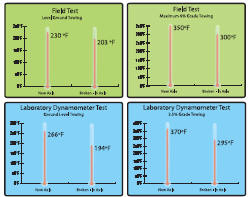
A light duty GM truck
towing 14,000 pounds was driven from Orange County, Calif. to the Nevada
state line. The test was conducted with both a new axle and a
broken-in axle. Over level ground towing, oil temperature was measured
at 230 degrees F in the new axle and 203 degrees F in the broken-in axle.
Oil temperature over the most grueling portion of the trip, during which a
maximum 6% grade was encountered, revealed the new axle was operating at 350
degrees F and the broken-in axle was operating at 300 degrees F.
Laboratory dynamometer test results simulating a truck hauling a trailer
provided similar results, with level ground towing temperatures recorded at
266 degrees F with the new axle and 194 degrees F with the broken-in axle
and towing temperatures (at a 3.5% grade) recorded at 370 degrees F with the
new axle and 295 degrees F with the broken-in axle. |
 |
AMSOIL SEVERE
GEAR™ 75W-90 and 75W-140 Synthetic Gear Lubes are formulated for severe
service applications, protecting differential gears for extended drain
intervals of up to 50,000 miles in severe service and 100,000 miles in
normal service, or longer where specified by the vehicle manufacturer.
Formulated with shear stable synthetic base stocks and an extra treatment of
additives, SEVERE GEAR™ Gear Lubes provide unsurpassed wear protection and
friction reduction, while their excellent thermal stability prevents thermal
runaway, a phenomenon caused by a lubricant’s inability to control friction
and increased heat under high stress conditions.AMSOIL SEVERE GEAR™ Synthetic Gear
Lubes are recommended for turbo diesel pick-ups, SUVs, vans,
delivery/utility vehicles, light, medium and heavy-duty trucks, buses, heavy
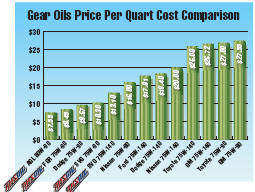
equipment, 4x4s, tow trucks, race cars, tractors and motor homes.AMSOIL Synthetic Gear Lubes
save motorists money through extended drain intervals, and they also cost
less per quart compared to many competing OEM gear lubes. |
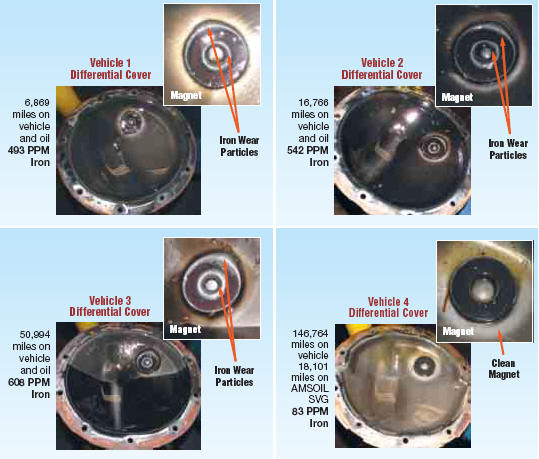 |
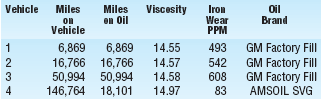
A test on four separate vehicles further demonstrated the
importance of changing the factory-fill gear lube within the first few
thousand miles. Oil analysis results revealed most of the wear in vehicle
one occurred within the first 6,869 miles. Despite higher mileages,
vehicles two and three only showed slightly higher iron wear than vehicle
one. Vehicle four was the only vehicle which had the factory-fill oil
changed to AMSOIL synthetic gear lube, and despite significantly higher
mileage than the first three vehicles, it showed a significantly lower level
of wear. The chart and photos provide visual evidence of the wear
materials present in the differentials of each vehicle. The photos
clearly show that the heaviest amount of wear occurs early in the break-in
period. Wear is
significantly reduced when the gear lube is changed to AMSOIL synthetic gear
lube following the break-in period.
|
 |
|
